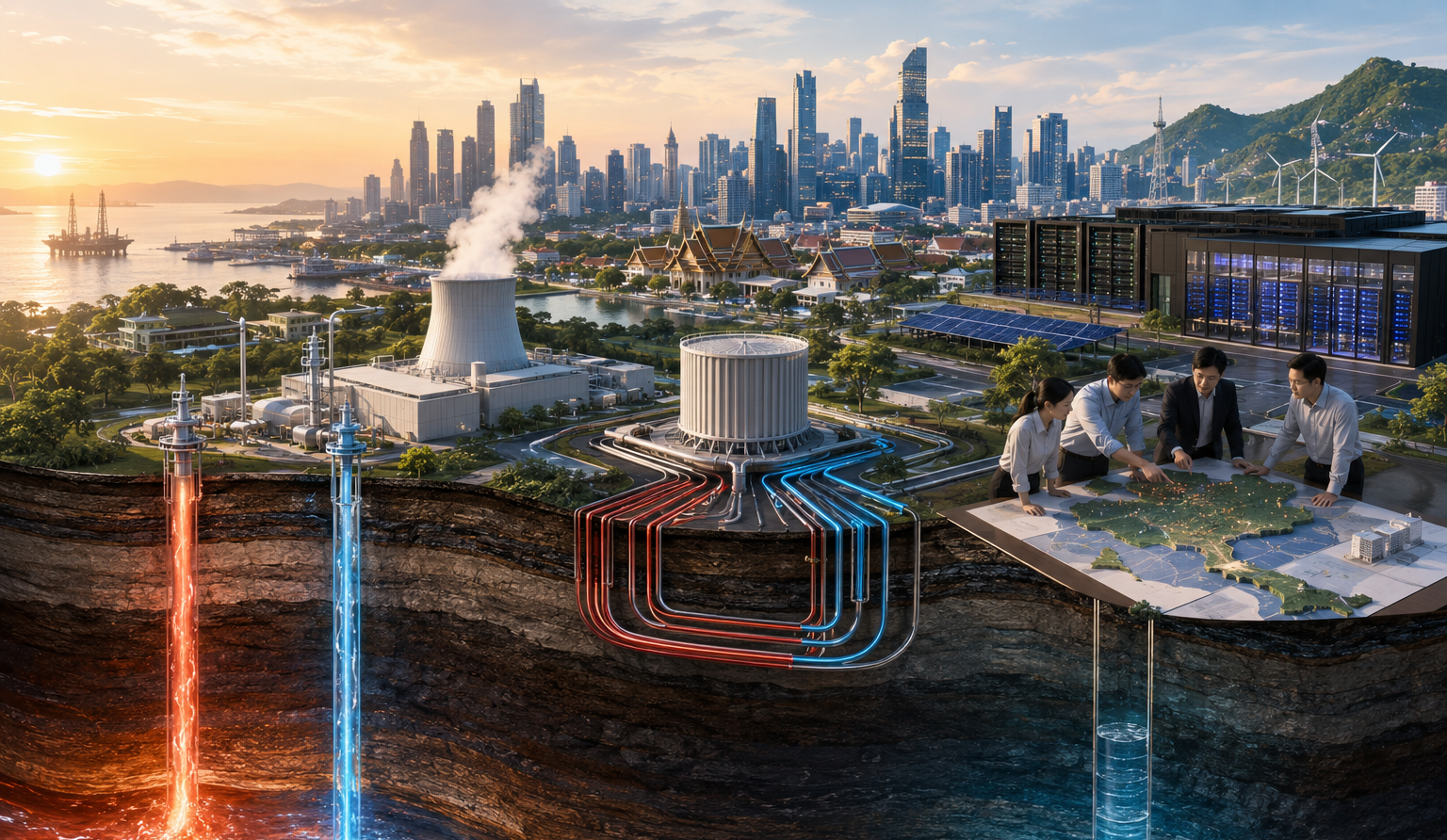
Why Should Geothermal Be in PDP2026?
Because the country's power development plan should not be built only around the energy sources we already have today. It must also open the way for Thailand to prove the energy of the future that may lie hidden beneath our own ground.
Geothermal has exactly the qualities Thailand's power system now needs. It is clean energy that can be generated continuously, 24 hours a day, independent of sun or wind. It strengthens the stability of renewables, reduces dependence on imported fuel, and can serve the demand for high-quality power from data centers and the industries of the future.
Importantly, Thailand is not starting from zero.
The global oil crises of 1973–1974 and 1979–1980 sent oil prices soaring and shook the Thai economy badly. But the generation before us did not settle for short-term fixes. EGAT established a "Special Energy Division" to study domestic energy sources — solar, wind, and geothermal heat.
That effort led to the construction of the 300-kilowatt Fang geothermal power plant in 1989, which proved something important:
Thailand can genuinely generate electricity from the heat beneath our own ground.
Nearly 50 years on, geothermal technology has advanced enormously. Knowledge from the shale oil and gas industry — both horizontal drilling and hydraulic fracturing — is now making Enhanced Geothermal Systems, or EGS, possible without having to sit near a volcano or on the Ring of Fire.
Fervo Energy has proven EGS at Project Red in Nevada, before scaling up to Cape Station in Utah, which is being developed toward 500 megawatts, with the site's potential reported to be as high as 4.3 gigawatts.
The question is: does Thailand have heat of the same kind?
Over nearly five decades, Thailand has drilled close to ten thousand petroleum wells, most of them in the Gulf of Thailand. A number of wells 3–4 kilometers deep have encountered temperatures above 200°C. Thailand also has rifted basins, granite belts running from the North down through the peninsula and into the Gulf, as well as major fault zones that may act as conduits carrying heat up from depth.
Onshore well data at Kamphaeng Saen and Thawi Watthana, along with a groundwater well roughly one kilometer deep at Samut Sakhon, also give signals that warrant further study.
None of this yet amounts to "proven reserves," but it is proof of heat — enough to justify Thailand beginning to prove up the resource systematically.
Another key lesson from the success of Thai petroleum is that subsurface resources are not developed by geology and technology alone.
Thailand had the Petroleum Act B.E. 2514 (1971), which clearly defined exploration and production rights, the concession system, timelines, work obligations, joint investment, regulatory oversight, and the benefits the state would receive.
That legal certainty attracted international oil companies to bring capital, technology, expertise, and risk-bearing capacity into exploring Thailand. The state therefore did not have to shoulder the entire risk of exploration drilling on its own. At the same time, Thailand gained data, knowledge, skilled people, revenue, and infrastructure — which later became the foundation of the Thai petroleum industry.
Geology tells us where the resource might be.
But clear law is what gives investors the confidence to go and look for it.
Geothermal needs a similar mechanism. It does not have to copy the petroleum law wholesale, but it does need clear rules on subsurface resource rights, exploration and drilling permits, land access, reinjection, data use and disclosure, seismic monitoring, decommissioning, and risk-sharing arrangements between the state and the private sector.
If it can be developed, geothermal will deliver more than clean 24/7 electricity. The residual heat can also be used for cooling, cold storage, drying agricultural products, aquaculture, and cascade-use air conditioning.
Including geothermal in PDP2026 therefore does not mean Thailand must announce thousands of megawatts right away. It should be included as a Clean Firm Power Technology Track, together with the establishment of a National Geothermal Proof Program: building a national resource map, opening up petroleum and groundwater well data, drilling deep exploration wells, and developing pilot projects on a stage-gate basis.
Prove first — scale when the data confirms it. Set the rules first — and capital and technology will follow.
Once before, Thailand turned data from beneath the ground into natural gas, which has been the backbone of the Thai economy for decades.
Thai petroleum did not come about because we already knew how much was down there. It came about because we dared to explore systematically, and because we had laws that made investors willing to take the risk alongside the country.
Today, PDP2026 should give Thailand the chance to do that once again — this time not to find fuel, but to find clean heat energy that is our own.