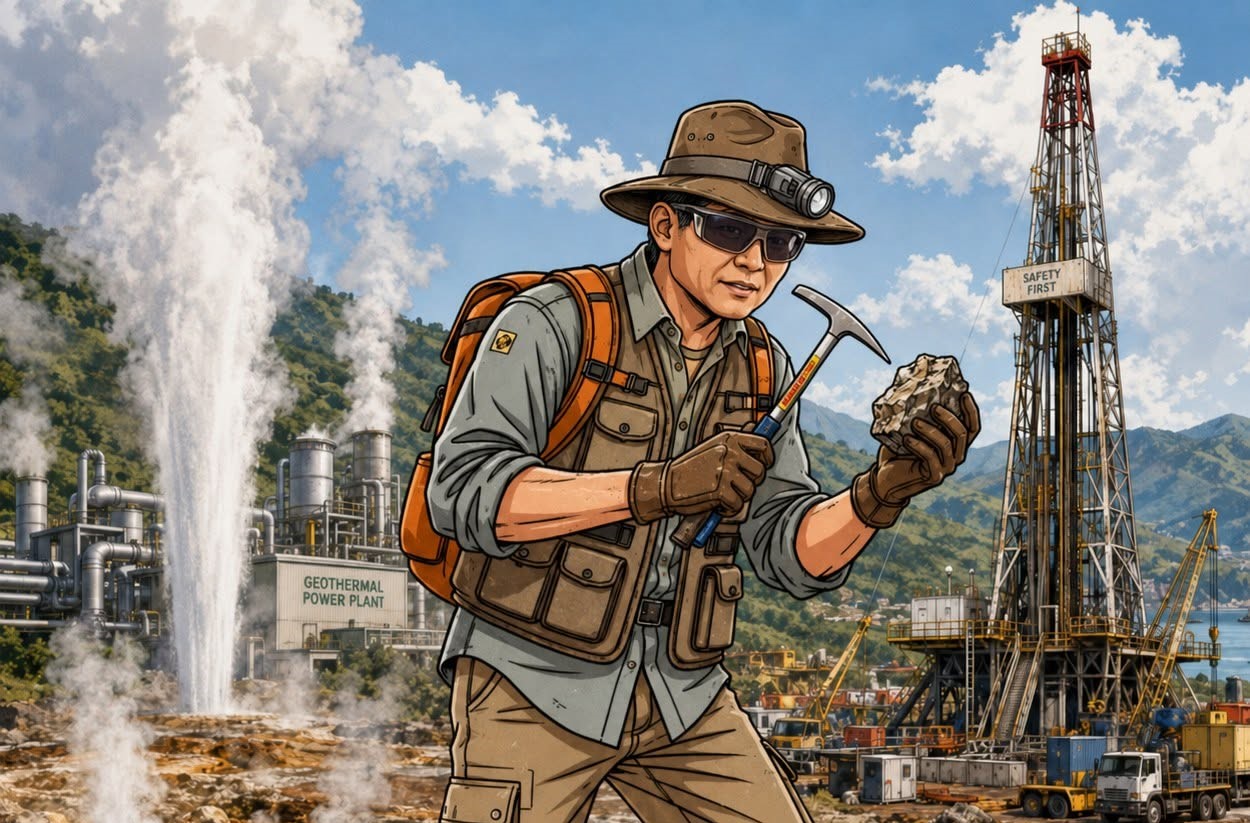
Over the past 50 years, Thai geologists have played an enormous role in the success of the country's petroleum industry.
We began with limited data — geological maps, stratigraphy, seismic data, well data, and interpretations of basin evolution — and from that starting point developed the natural gas fields of the Gulf of Thailand into one of the pillars of the nation's economy and energy security.
That success did not come from technology alone. It came from people: geologists, geophysicists, drilling engineers, reservoir engineers, and subsurface teams who gradually built a body of knowledge from Thailand's own real-world data.
Past: Thai Geologists Have Already Proven They Can Build a National Energy Industry
Thailand's petroleum industry grew out of decisions made on incomplete data — data that was nevertheless good enough to start exploring, drilling, developing, and learning continuously from the field.
Thai geologists were central to understanding the country's petroleum system: source rock, reservoir, seal, trap, and migration, all the way through to field development and production optimization.
This is invaluable experience, and it should not be allowed to quietly fade away as the petroleum industry's role diminishes in the years ahead.
Present: The Petroleum Momentum Is Still There, but the Role Is Changing
Petroleum remains important to Thailand today and is still a necessary baseload energy source for the economy. But the global direction is shifting unmistakably. Concerns about climate change, net zero, carbon footprint, and green energy are steadily challenging the role of fossil fuels.
What's interesting is that most of the knowledge and skill held by petroleum geologists has not lost its meaning at all. On the contrary, it is a critical foundation for developing geothermal energy — because geothermal is not simply a matter of hot springs. It is genuinely a subsurface energy business.
We still need to understand basins, basement, faults, fractures, stress fields, permeability, temperature gradients, heat flow, fluid flow, reservoir connectivity, and drilling risk exactly as before. The only thing that changes is the question: instead of asking "is there hydrocarbon?" we ask "is there enough heat, fluid, and permeability?"
Put simply, petroleum geologists don't have to start from zero. They just have to change lanes in time.
Future: Geothermal May Not Need the 50 Years Petroleum Did
In the past, the petroleum industry needed decades to accumulate data, train people, develop technology, and build investor confidence.
Geothermal today may not need nearly that long, because we already hold a large body of legacy data from the petroleum industry: well data, temperature data, pressure data, lithology, seismic, structural maps, and regional basin knowledge.
Beyond that, the world is entering an era in which AI, machine learning, cloud computing, remote sensing, GIS, geophysical inversion, and digital subsurface modelling can accelerate resource mapping and risk screening far beyond what was possible before.
Work that once took years to compile and interpret could be compressed into a matter of months, if we manage the data systematically.
Thailand should therefore not wait for geothermal to be "perfectly ready" before starting. In the new energy landscape, the advantage does not go to whoever has the most complete data — it goes to whoever can decide fastest on data that is reasonable enough.
How Thai Geologists Should Prepare
The first step is accepting that geothermal is a new opportunity for the geology profession, not something remote from it.
Younger geologists should build knowledge in geothermal systems, heat flow, hydrothermal alteration, fracture-controlled reservoirs, geomechanics, geothermal drilling, reservoir simulation, and techno-economic assessment.
Geologists with petroleum experience should move quickly to translate what they already know into geothermal exploration workflows:
- From petroleum basin analysis → geothermal play fairway analysis
- From reservoir characterization → heat-and-permeability characterization
- From fault seal analysis → fault-controlled fluid flow
- From well correlation → temperature-gradient and heat-flow modelling
- From field development plans → geothermal resource development plans
Thai universities should also update their curricula to keep pace. Geothermal shouldn't be a small chapter inside a renewable energy course; it deserves proper programs at the bachelor's and master's levels, along with short courses for working professionals.
Such programs should bring together geology, geophysics, reservoir engineering, drilling engineering, energy economics, energy law, and the use of AI and GIS in assessing site potential.
Because geothermal is not the work of a geologist alone. It is integrative work across geology, engineering, finance, policy, and regulation.
It's Time to Build Thailand's Geothermal Geologists
If Thailand is serious about net zero, data centers, energy security, and green baseload power, we need people who understand the country's subsurface in depth.
And the group best positioned to drive this forward fastest is Thai geologists — especially those who have already been through the field in the petroleum industry.
We built Thailand's petroleum industry from limited data 50 years ago. Today we have more data than before, better technology than before, faster AI than before, and a clearer energy imperative than before.
So the question is not whether Thailand has geothermal resources. It is how quickly we can prepare the people who can find, prove, and develop them.
Because in the new energy world, geothermal may no longer be an alternative energy source. It may become a new lifeline for Thailand's energy security in the decades ahead.